A Sailing Race or a Surf Contest: Two Different Ways to Read the Water
See how to read a sailing race or surf contest by following course, turns and progress, so the action makes sense from shore or water.
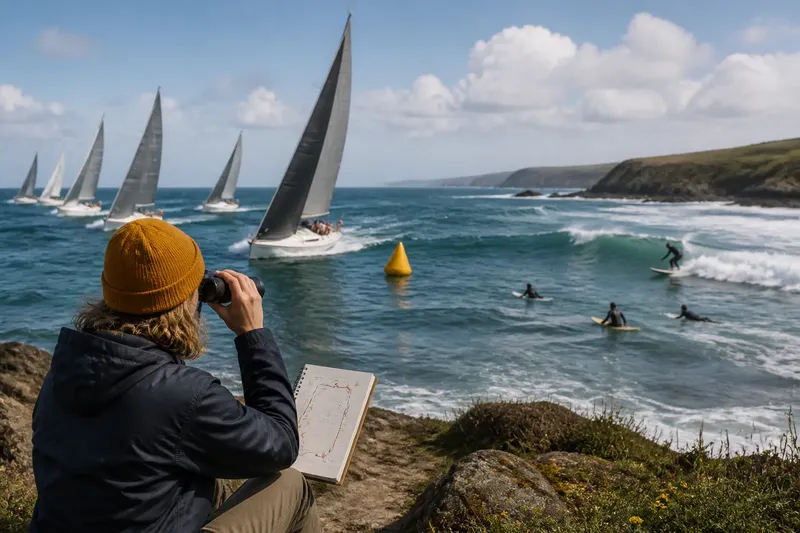
The most common mistake when watching a sailing race or surf contest is to look for the same sign of progress: a competitor moving steadily towards a finish. That works poorly at sea. A sailor may appear to head away from the mark to gain a better angle, while a surfer can wait in place for the wave that gives a meaningful scoring chance. Read each event on its own terms and the pauses, detours and sudden changes become part of the contest rather than interruptions.
A sailing race follows a course, not a straight line
In a sailing race, the course is a route laid out with marks, often buoys, that boats must round in a prescribed order. A start line sets the race in motion; later marks define where the fleet must turn; and the finish line settles the result. The exact layout varies, so a shore-side viewer should first find the course diagram or listen to the race briefing if one is available.
Wind direction shapes the route. A boat can sail directly downwind towards a mark, but it cannot point straight into the wind. To make progress upwind, sailors tack: they turn the bow through the wind and continue on the opposite side. From the beach, this can look like a needless zigzag. In practice, each leg is an attempt to reach the mark while keeping the sails drawing and choosing a useful line through shifting wind and water.
Think of the course as a set of stepping-stones across a stream: the destination matters, but the route between stones determines how easily you get there. A boat’s position against a mark, rather than its apparent distance from shore, is usually the more useful clue to its progress.
A surf contest follows a wave opportunity
A surf contest does not usually send every competitor around a fixed route. Surfers take turns within a heat, paddling into waves and trying to ride them in ways that judges can score. The contest area is a stretch of water, not a lane. Its useful boundaries and the rules for wave priority depend on the event format.
Here, progress is less about covering distance than making a ride count. A surfer may paddle, sit beyond the breaking waves or reposition after a ride. Those actions can look inactive beside the continuous movement of a sailing fleet, but they help the surfer find a suitable wave and preserve an opportunity to compete. Once on a wave, the quality and control of the ride matter more than how far the surfer travels along the beach.
For spectators, the challenge is to distinguish waiting from losing position. Watch where surfers sit relative to the breaking waves and to one another. Then follow each ride from take-off to finish, noticing whether the surfer maintains control and links manoeuvres rather than judging only by distance or splash.
Turns reveal different kinds of judgement
In sailing, a turn is a tactical change of direction that keeps the boat on course. At a mark, boats must round it in the required direction and avoid fouling one another. Between marks, a tack or a downwind turn may be chosen to respond to wind shifts, traffic or the shape of the course. The turn is part of the route, and a clean, timely one can preserve a boat’s place in the fleet.
In surfing, turns are movements on the face of a wave. They are judged as elements of the ride: a surfer may change direction, strike a section or redirect towards another part of the wave. A turn that looks dramatic from shore does not automatically tell the whole story. The judges assess the complete ride under the contest’s criteria, including how well the surfer uses the available sections and stays in control.
The shared word can mislead. A sailing turn changes where a boat goes next; a surfing turn is something a competitor performs on the wave. Keeping that distinction in mind helps a viewer follow each event without importing the logic of one into the other.
Progress is measured against different limits
A sailing fleet makes progress by completing the course in the required order. Boats are compared with one another, and the finish is decisive; race formats may also apply handicap or scoring rules. A boat that seems to lead from one vantage point may not be first on the water, because perspective, course shape and the location of the next mark can distort the view.
In a surf heat, progress is built from scoring rides. Contestants generally need to make the most of their available wave opportunities, and the scoring system determines how rides contribute to the heat result. The ranking may change after a strong ride, even if the surfer has spent much of the heat waiting. The leaderboard, when displayed, is more reliable than guessing from how many waves each person has ridden.
Imagine a spectator watching from a headland as a sailing boat tacks away from the nearest buoy, while a surfer sits beyond the break without catching a wave. The spectator checks the course map and sees the boat is aiming for the next upwind mark; then the heat scores show that the surfer’s earlier ride still counts. The observable result is a clearer reading of both contests: one competitor is advancing by a route decision, the other is being assessed through completed rides.
Where should you look to follow each contest?
What should I watch first in a sailing race?
Find the start, the next mark and the direction of the wind. Once you know which mark the boats are approaching, their tacks and changes in relative position are easier to interpret.
Why do sailors tack instead of steering straight to a mark?
A boat cannot sail directly into the wind, so it changes tack to make headway upwind. The chosen path also reflects wind and fleet position, which can make one boat’s route differ from another’s.
What counts as progress in a surf contest?
Progress is shown by rides that earn scores under the event’s judging criteria, not simply by paddling or catching the most waves. Check the heat scores to see how completed rides affect the standings.
Why can a surfer wait so long between rides?
The surfer is looking for a wave that offers a worthwhile chance to perform, while keeping a useful position in the contest area. Waiting is part of choosing when to commit, rather than evidence that the heat has stopped.
Use the event’s own information before judging the action
For a sailing race, a course board or event map gives the marks and their order; a race officer’s announcements may explain a changed course. For a surf contest, the heat schedule, priority notices and live scores clarify who is riding and how rides count. Where the right interpretation depends on event rules, follow the organisers’ published instructions.
From shore, visibility can be limited by glare, swell and the angle of the beach. A pair of binoculars may help with distant boats, while a course map can be more useful than trying to track every tack. At a surf contest, staying where the break and the scoring display are both visible can make the sequence easier to follow.
To read a sailing race or surf contest well, ask a different question of each: which mark is the boat trying to round, or which ride is likely to shape the heat? Those questions keep attention on the real measure of progress. Once that measure is clear, a detour at sea and a long wait beyond the break can both make sporting sense.