How the Seaside Lido Became a Sporting Venue
Seaside lido history traces how places such as Tynemouth and Penzance made swimming public, organised and social, and what shaped their sporting role.
The common mistake in seaside lido history is to imagine one standard pool spreading along the coast. The record is less tidy: some venues were built as bathing pools, while others grew from bathing places beside natural water. Treating them as the same kind of venue blurs the sequence by which public bathing, organised swimming and coastal leisure came together.
Early lidos offered a managed alternative to open-water bathing
In Britain, seaside bathing places took different forms before “lido” settled into its familiar association with an outdoor swimming pool. A bathing place could use a sheltered part of the shore, while a later venue might add a constructed pool, changing rooms or areas for spectators. The distinction matters: a lido did not have to begin as a purpose-built sports facility.
At Tynemouth, the Long Sands bathing pool opened in 1877, providing a pool beside the North Sea rather than asking swimmers to rely on the open beach alone. The example shows an early practical change: swimming could take place in a defined space with a separate public identity. It does not mean all seaside lidos followed the same design or timetable.
Purpose-built pools made swimming easier to organise
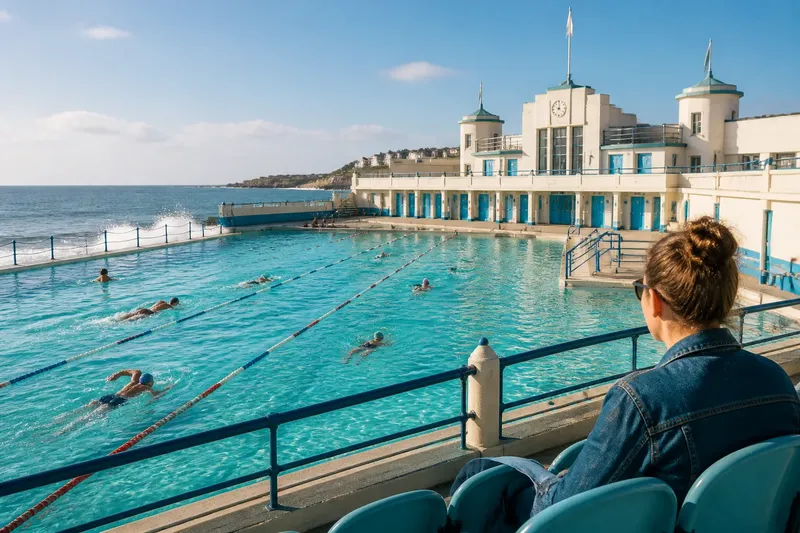
By the early twentieth century, new lidos could be designed as destinations for both swimming and leisure. Jubilee Pool in Penzance, which opened in 1935, is a striking example: its large art deco saltwater pool was built on the seafront, with the open sea close by but the swimming area clearly bounded. The pool made swimming a scheduled, shared activity rather than an encounter governed only by tide and surf.
That boundary also supported sport. A defined pool gave instructors and clubs a consistent place to meet, while steps and pool edges offered clear points for entering, leaving and observing. Changing rooms made a swim part of an outing rather than an improvised stop at the shore. The arrangement resembles a village green with marked paths: the space sets useful limits, but people give it its daily character.
Club swimming turned public pools into sporting venues
A pool becomes a sporting venue through its use as well as its architecture. Club sessions, lessons and organised swimming need access to water at agreed times; a lido can provide that structure while retaining public sessions for people who simply want to swim. The same pool may therefore be a training space in one part of the day and a place for casual bathing in another.
This blend is visible in how a venue is arranged and run. A timetable can separate club use from general admission; a viewing area can let family members watch; changing facilities can support repeated visits. None of these details alone makes a lido a sports ground. Together, they allow sporting routines to coexist with ordinary public use.
Later lidos adapted unevenly to changing leisure
As leisure habits and local provision changed, seaside lidos took different paths. Some continued to operate as swimming venues, some changed their facilities or programme, and others closed or became landmarks rather than everyday places. These are distinct outcomes, not a single decline shared by every lido.
Jubilee Pool in Penzance remains an operating public pool, while Tynemouth’s Long Sands pool is a historic example rather than a current swimming venue. Putting the two side by side makes the sequence clearer: a lido’s sporting role depends not just on its original design, but on whether people can still use it and how its present-day programme is organised.
What should visitors check before choosing a lido?
- Observe whether the venue lists public swimming sessions; if it does, choose a suitable session, but if it does not, check for an alternative public pool or open-water venue.
- Observe whether the timetable reserves water for clubs or lessons; if it does, plan around those periods, but if session details are unclear, contact the venue before travelling.
- Observe whether changing rooms and showers are open; if they are, plan to use them, but if they are closed or unavailable, decide whether you can manage without them or choose another venue.
- Observe whether the venue describes its water as a constructed pool or a natural bathing area; if it is a pool, follow the pool’s entry rules, but if it is natural water, check local conditions and posted guidance.
- Observe whether spectators are permitted in viewing areas; if they are, arrange to watch from there, but if they are not, follow the venue’s access rules rather than entering restricted areas.
- Observe whether the venue publishes current opening and access information; if it does, use that before setting out, but if the information is missing or ambiguous, contact staff or choose a venue with clear arrangements.
Say you are planning a swim at Jubilee Pool and want to visit with a friend who prefers to watch. You check the current timetable and see a public session that suits you, then confirm that the viewing area is open; you also find that changing facilities are available. The resulting plan is a public swim with your friend watching from the designated area. If the timetable instead shows a closed session, you would choose another public time or postpone the visit, rather than assuming the pool is available.
What do readers ask about seaside lidos?
Did every seaside lido start as a swimming pool?
No. Some began as bathing places beside natural water, while others were built as pools. The word now often suggests an outdoor pool, but it does not describe one uniform history.
When did lidos become sporting venues?
There was no single turning point. Defined pools could support lessons and club sessions once local programmes and access arrangements made organised swimming possible.
What is the difference between a lido and a beach?
A lido offers a managed swimming space, which may be a constructed pool or, in some cases, a bathing place beside natural water. A beach gives access to open coastal conditions, where tides, surf and local guidance shape the swim.
Can a lido still serve casual swimmers and clubs?
Yes, if its timetable and facilities make room for both. Check the specific venue’s current programme, since access and activities vary.
Seaside lido history is written in continued public use
The change from bathing place to sporting venue was not a universal march from shore to pool. Tynemouth’s historic bathing pool and Penzance’s purpose-built Jubilee Pool show different points in that history: one offered a defined place for swimming beside the sea; the other made pool swimming a planned coastal destination. Their contrast helps explain why a lido’s sporting identity depends on both its form and its public life.
For a visitor, the most useful clue is the current timetable, not the building’s appearance. A venue that makes its public sessions, club use and access arrangements clear gives you a better basis for planning than its name or seaside setting alone.